For a long time, E-Max (lithium disilicate) was the go-to choice for porcelain veneers. It changed cosmetic dentistry by letting patients choose thin, translucent restorations instead of thick, opaque crowns. But dental technology doesn't stand still. Today, a new material called Celtra Duo is changing what we can do in smile design. By mixing zirconia into lithium silicate glass, this advanced material gives us a wonderful balance of strength, thinness, and natural light transmission.
At Dent of Istanbul, we always keep up with the latest in dental technology. In our own in-house laboratory, our master ceramists craft custom Celtra Duo veneers using high-precision digital milling. Led by Dr. Nilgün Başar, we customize each veneer to give you a beautiful, long-lasting smile while keeping as much of your natural tooth structure intact as we can.
The Science of ZLS: Zirconia-Reinforced Lithium Silicate
To understand why Celtra Duo represents a major step forward, it helps to look at its composition. Celtra Duo is a Zirconia-Reinforced Lithium Silicate (ZLS) ceramic developed by Dentsply Sirona. It contains approximately 10% zirconia dissolved at a molecular level into a lithium silicate glass matrix.
This unique mix gives you two main benefits:
- Ultra-Fine Crystalline Structure: The addition of zirconia prevents crystal growth during manufacturing, resulting in crystals that are four to six times smaller than those in standard lithium disilicate. This extremely fine structure allows the material to scatter light in a way that closely mimics the natural way human teeth reflect light.
- High Edge Stability: Traditional glass-ceramics can become brittle at the edges when milled very thin. The zirconia reinforcement in Celtra Duo provides high flexural strength and fracture toughness, allowing our lab technicians to mill the margins (edges) of the veneer down to an ultra-thin 0.3mm without having to worry about tiny cracks during the milling or bonding process.
Celtra Duo vs. E-Max: A Head-to-Head Comparison
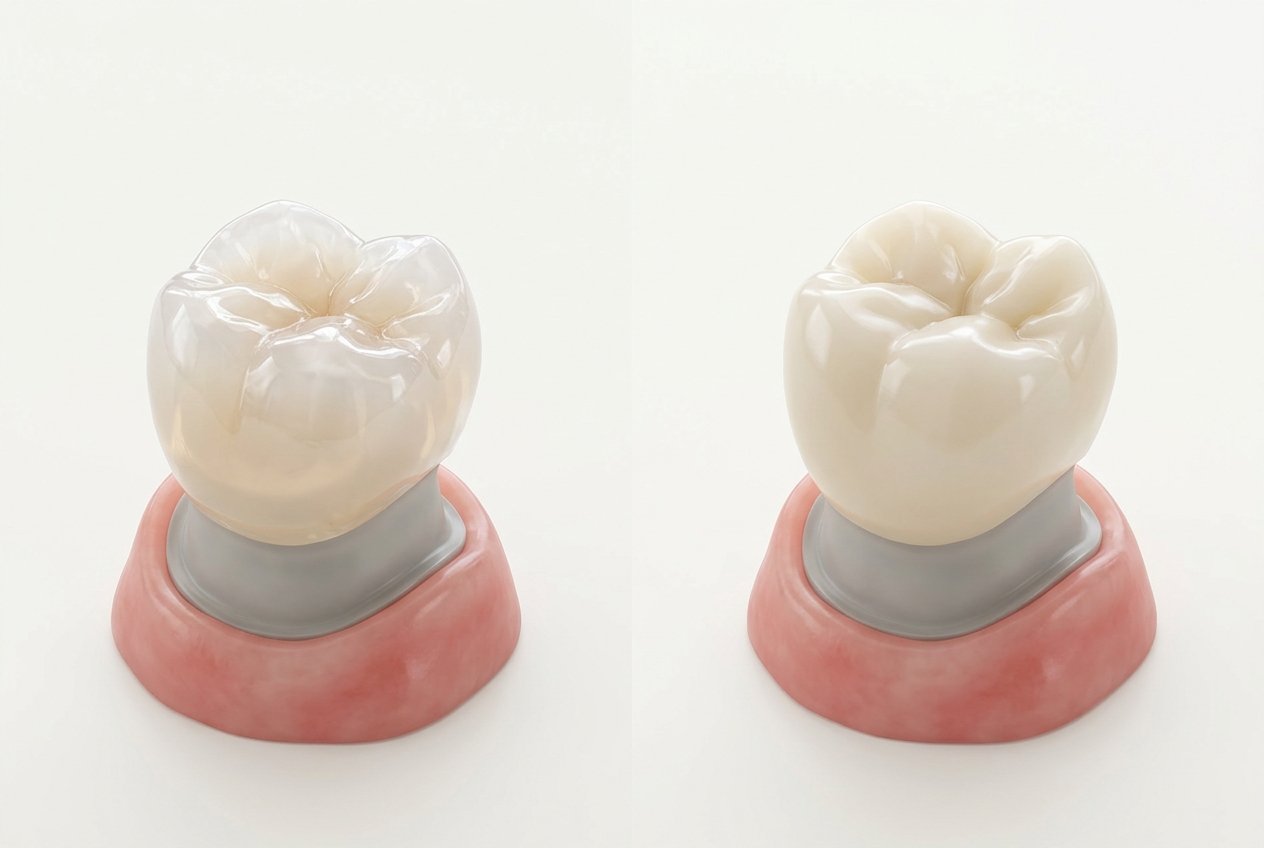
If you are planning a smile makeover, you might be wondering whether to go with E-Max or Celtra Duo. Both are high-end, high-quality materials, but they work best in different situations:
| Clinical Metric | E-Max (Lithium Disilicate) | Celtra Duo (Zirconia-Reinforced) |
|---|---|---|
| Flexural Strength | ~500 MPa | Up to 560 MPa (fully fired and glazed) |
| Minimum Thickness | 0.4mm – 0.5mm | 0.3mm (Ultra-thin) |
| Chameleon Effect | Good (provides excellent depth) | Exceptional (blends with adjacent teeth) |
| Enamel Shaving Required | Conservative (0.5mm average) | Minimal (0.3mm average) |
| Best Suited For | Full arch makeovers, masking dark stains | Minimal-prep veneers, single-tooth restorations |
1. Translucency and the Chameleon Effect
Because Celtra Duo's crystals are so small, the material has a high refractive index. When placed over a natural tooth, it allows the natural shade of the underlying dentin to shine through, adapting to the color of the surrounding teeth. This blending ability makes Celtra Duo perfect for partial smile makeovers, where we are only placing a few veneers next to your natural teeth. E-Max, on the other hand, is a bit more opaque, which makes it excellent for covering up dark stains or old metal fillings.
2. Conservation of Enamel
The strongest bond we can get in cosmetic dentistry is between the adhesive and your natural tooth enamel. Bonding to the deeper layer, called dentin, is weaker and can let moisture or bacteria sneak in over time. Because Celtra Duo can be milled down to just 0.3mm without losing its strength, Dr. Nilgün Başar can be incredibly conservative, leaving almost all of your natural enamel in place. This makes the bond much stronger and longer-lasting while keeping any sensitivity after the procedure to a minimum.
Find Your Perfect Veneer Material
Every smile is unique. Send a photograph of your teeth to our clinical specialists on WhatsApp. Dr. Nilgün Başar's team will evaluate your bite and recommend the ideal material within hours.
The Digital Workflow at Dent of Istanbul
At Dent of Istanbul, we combine high-end Celtra Duo materials with a fully digital process to give you a beautiful new smile in just a few days. Here is how we do it:
1. 3D Intraoral Scanning
We begin by capturing a highly detailed 3D digital model of your teeth using our intraoral scanners. This eliminates the need for traditional, uncomfortable silicone impressions and ensures a highly accurate digital model of your mouth.
2. CAD/CAM Designing
Using specialized dental design software, our master ceramists design the shape, length, and alignment of each individual veneer. We take your facial features, lip line, and natural bite into account to create a balanced, harmonious smile.
3. High-Precision Milling
The digital design is sent to our in-house CAD/CAM milling machine, which carves the veneers from a solid block of Celtra Duo ZLS ceramic. The precision of our milling machines ensures that the veneers fit your prepared teeth with micrometer accuracy, leaving no gaps for bacteria to enter.
4. Custom Glazing and Firing
Once milled, our master ceramists hand-characterize each veneer, adding subtle shade variations and surface textures to mimic natural enamel. The veneers are then fired in our laboratory furnace at high temperatures, activating the zirconia particles and bringing the material to its final strength of 560 MPa.
Why Choose Celtra Duo in Turkey?
Heading to Turkey for your cosmetic dentistry can save you a lot of money without compromising on the quality of your care. In places like the UK, Germany, or the US, Celtra Duo is considered a high-end option and often costs between €1,000 and €1,500 per tooth because of high lab fees.
At Dent of Istanbul, because we have our own in-house lab and lower operational costs, we can offer Celtra Duo veneers for a fraction of that price, usually between €300 and €400 per tooth. This means you get world-class cosmetic treatment using the latest materials while enjoying a wonderful trip to the beautiful city of Istanbul.