When you decide to invest in a smile makeover, your primary goal is likely to achieve a result that looks completely natural. You want a smile that appears bright, healthy, and alive, rather than a row of opaque, chalky white caps. In cosmetic dentistry, glass-ceramic materials are the gold standard for achieving this lifelike quality because of how they transmit light.
However, navigating the material options can be confusing. You have likely heard of E-Max, the long-reigning king of cosmetic veneers. But during your research, you may also encounter Celtra Duo, a next-generation ceramic reinforced with zirconia. Both materials offer beautiful results, but they differ in their structure, strength, and how they are prepared on your teeth.
What are Glass-Ceramic Veneers? The Secret to Translucency
To understand why E-Max and Celtra Duo are highly regarded, it helps to look at the physics of a natural tooth. Human teeth are not solid, opaque white structures. They are composed of a dense inner layer of dentin covered by a highly translucent outer layer of enamel. When light hits a tooth, it does not just bounce off the surface; it penetrates the enamel, scatters within the dentin, and reflects back out. This gives teeth their characteristic depth and luster.
Older dental materials, such as metal-ceramic crowns or basic zirconia, often block this light, resulting in a flat, artificial appearance. Glass-ceramics mimic the optical properties of natural enamel. They allow light to pass through the restoration and reflect off the underlying tooth structure, creating a seamless blend with your natural smile.
What is E-Max? The Time-Tested Gold Standard
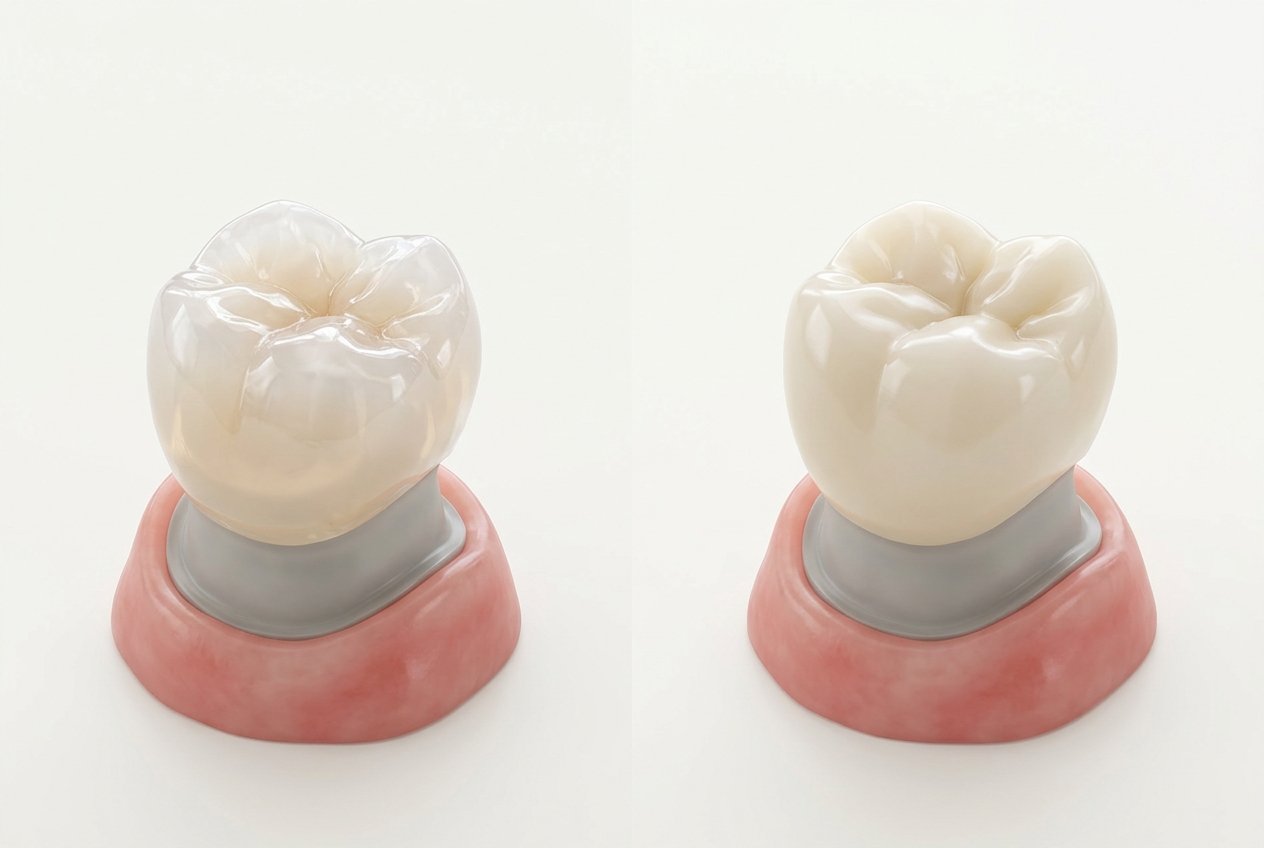
E-Max, manufactured by Ivoclar Vivadent, is a lithium disilicate glass-ceramic. It has been used in cosmetic dentistry for over two decades and boasts a long-term clinical survival rate of over 98%. It is the material responsible for the modern transition away from thick, artificial-looking veneers to natural, highly customized smile designs.
The Science of Lithium Disilicate
Lithium disilicate is a glass-ceramic material composed of needle-like crystals scattered throughout a glass matrix. This unique microstructure gives E-Max a high resistance to fractures while maintaining the optical qualities of glass. When milled from a single monolithic block, it provides uniform strength and color, eliminating the risk of chipping that can occur with layered ceramics.
Why E-Max Dominates Cosmetic Dentistry
E-Max is highly favored by cosmetic dentists and master ceramists because of its versatility. It can be custom-shaded, characterized, and glazed to match any natural tooth shade, from a warm, subtle ivory to a bright bleach shade. Because it is highly translucent, it is ideal for patients who want to cover minor stains or chips while preserving the natural variations in shade across their teeth.
What is Celtra Duo? The Next-Generation ZLS Ceramic
While E-Max remains a benchmark, materials science continues to progress. Celtra Duo, developed by Dentsply Sirona, represents the next generation of glass-ceramics. It is a Zirconia-Reinforced Lithium Silicate (ZLS) ceramic.
The Magic of Zirconia-Reinforced Lithium Silicate
By dissolving approximately 10% zirconia into the lithium silicate glass matrix at a molecular level, engineers created a material that combines the optical beauty of glass-ceramic with the structural reinforcement of zirconia. The result is a ceramic with an ultra-fine crystalline structure. The tiny size of these crystals allows Celtra Duo to scatter light in a way that closely mimics the natural "chameleon effect" of human teeth. It naturally absorbs and reflects the color of the surrounding teeth, making it highly effective at blending in.
How Celtra Duo Achieves Ultra-Thin Profiles
The addition of zirconia increases the strength of the material, particularly at the margins (edges) of the restoration. This allows our technicians to mill Celtra Duo veneers incredibly thin—down to 0.3mm. Because the material is stronger at thinner dimensions, it requires less tooth preparation, allowing us to preserve more of your natural enamel.
Head-to-Head: E-Max vs. Celtra Duo Veneers
When comparing these two certified high-end materials, we look at several key clinical performance factors:
1. Aesthetics, Translucency, and the "Chameleon Effect"
E-Max offers a deep, warm shade depth, making it excellent for patients who want a complete smile makeover where we are designing a uniform, customized shade from scratch. Celtra Duo, due to its ZLS structure, has an outstanding chameleon effect. If we are replacing only one or two visible teeth, Celtra Duo is often superior because it naturally adapts to the shade of the adjacent natural teeth, making the boundary of the restoration invisible.
2. Flexural Strength and Resistance to Chipping
Standard monolithic E-Max has a flexural strength of approximately 500 MPa. Celtra Duo, when fully fired and glazed in our laboratory furnace, can reach up to 560 MPa. Both materials are exceptionally strong and more than capable of handling daily chewing forces. However, Celtra Duo's zirconia reinforcement gives it slightly better edge stability, reducing the risk of micro-chipping along the margins during the milling and cementation process.
3. Tooth Preparation (Traditional vs. Minimal-Prep)
This is a major consideration for patients who are anxious about having their teeth shaved down. Because Celtra Duo is stronger at thinner dimensions, we can often perform ultra-conservative, minimal-preparation treatments. While E-Max veneers typically require 0.4mm to 0.5mm of enamel reduction, Celtra Duo can often be placed with just 0.3mm of preparation. Preserving enamel is vital because dental adhesives bond significantly stronger to natural enamel than to the underlying dentin.
4. In-House CAD/CAM Milling and Customization
Both materials are highly compatible with modern digital dentistry. At Dent of Istanbul, we use advanced in-house CAD/CAM milling machines to fabricate your restorations. Celtra Duo can be milled and polished very quickly, which can reduce the time you spend in the dental chair. E-Max, while requiring a slightly longer crystallization process in the furnace, allows our master ceramists to apply detailed, hand-painted characterizations for a highly customized look.
Comparison Table: E-Max vs. Celtra Duo at a Glance
Below is a summary of how these two high-end glass-ceramics compare across key metrics:
| Metric | E-Max (Lithium Disilicate) | Celtra Duo (ZLS) |
|---|---|---|
| Material Composition | Lithium Disilicate | Zirconia-Reinforced Lithium Silicate (ZLS) |
| Flexural Strength (MPa) | ~500 MPa | Up to 560 MPa (fully fired) |
| Standard Thickness | 0.4mm – 0.5mm | 0.3mm – 0.4mm (Ultra-thin) |
| Translucency Level | Very High | High (with high light-scattering) |
| Chameleon Effect | Good | Outstanding (blends with adjacent teeth) |
| Ideal Use Case | Full smile transformations, custom shades | Minimal-prep veneers, single-tooth matching |
Not sure if your bite is suited for E-Max or Celtra Duo?
Send our clinical team a quick photo of your smile on WhatsApp. Dr. Nilgün Başar's team will review it and recommend the ideal material within hours.
The Expert Verdict: Dr. Nilgün Başar's Recommendations
At Dent of Istanbul, we do not believe in pushing one material over another. Instead, our lead cosmetic specialist, Dr. Nilgün Başar, selects the material based on your specific dental health, bite alignment (occlusion), and aesthetic goals.
When We Choose E-Max for Your Smile
Dr. Nilgün Başar frequently recommends E-Max for patients who are looking for a complete cosmetic transformation (typically 10 to 20 veneers). If you want to change the overall shade of your smile to a bright, uniform bleach shade, E-Max is the ideal choice. It provides the necessary opacity to mask mild underlying tooth discoloration while maintaining a natural, lifelike glaze.
When Celtra Duo is the Superior Option
Conversely, Celtra Duo is often the preferred choice if you only need a few veneers to correct minor imperfections, such as a chipped front tooth or a small gap. The chameleon effect of Celtra Duo ensures that the restoration blends in with your remaining natural teeth. It is also the ideal choice for patients who want minimal-preparation veneers, as the strength of ZLS allows us to preserve more of your natural enamel.
The Dent of Istanbul Advantage: In-House Master Ceramists
Even the most advanced dental material will look artificial if it is fabricated poorly. A high-end ceramic in the hands of an inexperienced laboratory can result in bulky, ill-fitting restorations. At Dent of Istanbul, we feature our own in-house CAD/CAM dental laboratory, staffed by master ceramists who specialize in glass-ceramic restorations.
Because our lab is on-site, our ceramists can physically inspect your teeth, match the shade under clinical lighting, and make immediate adjustments to the glaze or shape. If a veneer needs a slight modification, we can refine and refire it in our laboratory furnace within minutes, rather than sending it back and forth to an external lab. We stand behind the quality of our work, backing both E-Max and Celtra Duo restorations with a written 5-year guarantee.
Frequently Asked Questions (FAQs)
Do Celtra Duo veneers look natural?
Yes. Celtra Duo veneers look exceptionally natural due to their zirconia-reinforced lithium silicate composition. The dissolved zirconia particles create a high light-scattering effect that mimics the natural light transmission of human teeth, allowing the veneer to blend with the surrounding tooth structure.
Is Celtra Duo stronger than E-Max?
Celtra Duo has a slight edge in flexural strength when fully fired in a laboratory furnace, reaching up to 560 MPa compared to E-Max's 500 MPa. This higher strength allows Celtra Duo to be milled thinner (down to 0.3mm) while maintaining excellent edge stability and resistance to chipping.
How long do these glass-ceramic veneers last?
Both E-Max and Celtra Duo are highly durable glass-ceramics. With proper oral hygiene, regular dental check-ups, and the use of a protective nightguard if you grind your teeth, you can expect these high-end restorations to last between 10 and 15+ years.
Does getting glass-ceramic veneers hurt?
The procedure is completely comfortable. At Dent of Istanbul, we perform tooth preparation under local anesthesia, and we offer conscious sedation for patients who experience dental anxiety. Post-operative sensitivity is minimal and temporary.