When a tooth has some moderate decay or structural damage, many people assume their only choices are a simple filling or a full dental crown. But there is a really great middle ground that modern dentistry prefers. Inlays and onlays, which are often called partial crowns, allow us to restore your tooth's strength and shape without shaving away healthy enamel. By choosing this gentler approach, you keep the natural foundation of your tooth intact while still getting a highly durable, beautiful restoration.
At Dent of Istanbul, we believe in keeping as much of your natural tooth as possible. Led by Dr. Nilgün Başar, our clinical team uses advanced digital design and milling technology to create custom porcelain inlays and onlays that fit your teeth with micrometer precision. If you are planning a dental trip to Turkey, understanding how these restorations work can help you make the best decision for your smile.
What Are Inlays and Onlays?
Inlays and onlays are what dentists call indirect restorations. This just means they are custom-made outside of your mouth in a dental laboratory, rather than being molded directly onto your tooth like a standard white composite filling. We typically craft them from medical-grade porcelain or zirconia-reinforced ceramics so they match the natural color, translucency, and feel of your teeth.
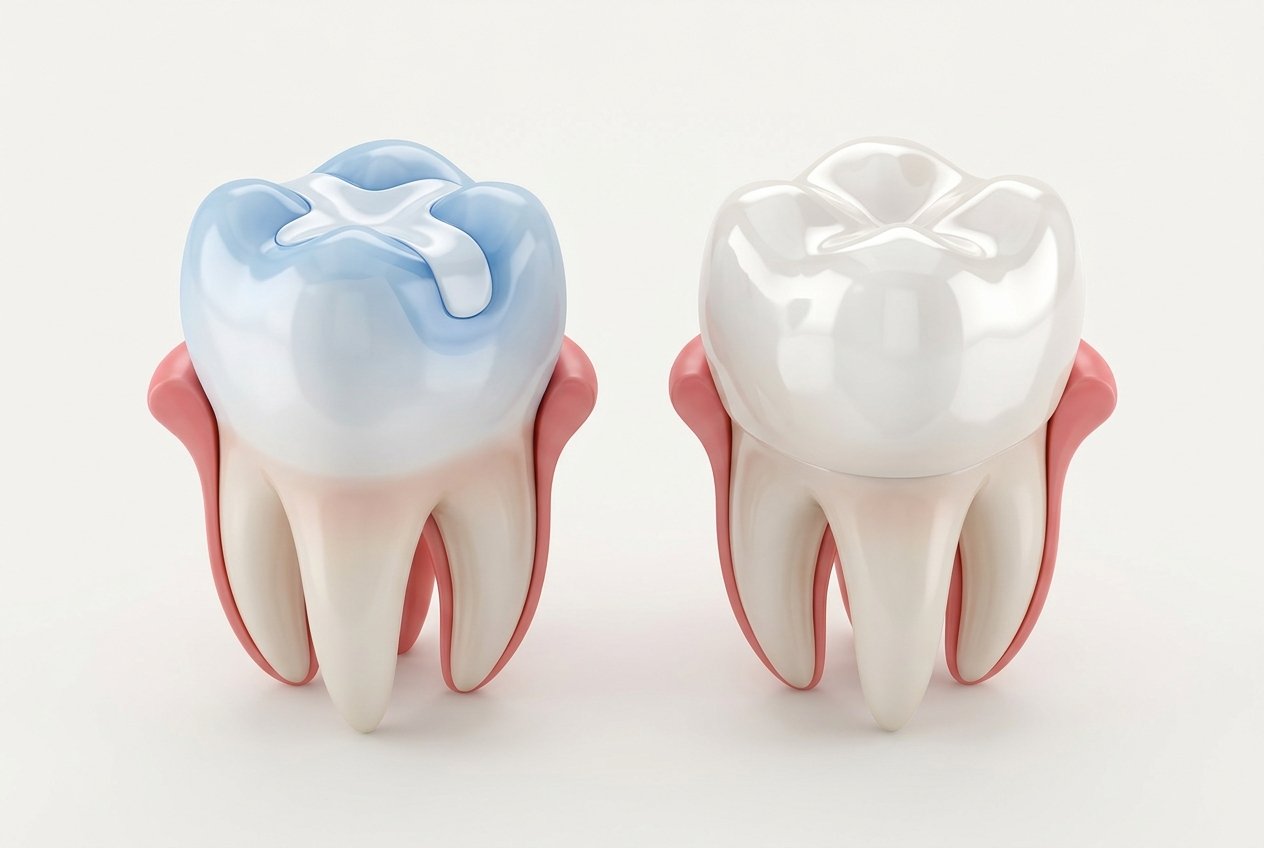
- Inlays: An inlay fits right inside the grooves of a tooth's chewing surface. We use it when the damage or decay is sitting safely within the cusps, which are the pointed edges of the tooth. It replaces what would traditionally be a large filling but offers much better strength and longevity.
- Onlays: An onlay is a bit more extensive. We use it when the damage extends to one or more of the cusps or covers the entire biting surface of the tooth. Because they cover the chewing surface, onlays are often referred to as partial crowns.
The Conservative Advantage: Why Less is More
The main reason to choose an inlay or onlay over a full crown is that it saves your natural tooth structure. To place a traditional dental crown, a dentist has to shave down the tooth on all sides, removing up to 60% or even 75% of its healthy structure. Once that is done, there is no going back.
Keeping your natural enamel is incredibly important because the bond between porcelain and natural enamel is the strongest bond we can achieve in dentistry. By keeping the healthy parts of your tooth intact, we preserve the natural flex and strength of the tooth when you chew. This greatly reduces the risk of the tooth snapping at the gumline in the future, which is a very common problem when a tooth has been heavily shaved down for a full crown.
Comparing Restorations: Fillings, Inlays/Onlays, and Crowns
To help you see where inlays and onlays fit into your options, here is a quick comparison of the three main ways we restore teeth:
| Feature | Composite Filling | Porcelain Inlay / Onlay | Full Dental Crown |
|---|---|---|---|
| Tooth Preservation | High (only decay is removed) | High (preserves healthy walls/enamel) | Low (requires 360-degree shaving) |
| Material | Composite Resin (Plastic & Glass) | Feldspathic Porcelain or E-Max Ceramic | Zirconia, E-Max, or Metal-Ceramic |
| Durability & Strength | Moderate (prone to wear and shrinkage) | Very High (highly resistant to biting forces) | Very High (protects brittle teeth) |
| Stain Resistance | Poor (discolors over time) | Excellent (impervious to staining) | Excellent (impervious to staining) |
| Average Lifespan | 5 – 7 Years | 10 – 15+ Years | 10 – 15+ Years |
Why Composite Fillings Fail in Large Cavities
A lot of people ask why they cannot just get a standard white filling for a larger cavity. When a cavity takes up more than 30% of a tooth's width, a direct composite filling simply cannot hold up structurally. Composite resin goes in as a soft paste and is cured with a blue light. During this curing process, the resin shrinks slightly, pulling away from the cavity walls by about 1% to 3%.
In a small cavity, this shrinkage is too tiny to cause issues. But in a large cavity, it creates microscopic gaps along the edges. Over time, bacteria sneak into these gaps, leading to new decay underneath the filling. On top of that, composite resin is relatively soft. Under the heavy chewing forces of your back teeth, which can easily exceed 70 kg, a large filling will gradually warp, chip, or even crack the remaining thin walls of your natural tooth. Porcelain inlays and onlays do not shrink, do not wear down, and actually make the tooth stronger by bonding the remaining walls back together.
Preserve Your Natural Teeth with Advanced Ceramics
Unsure if your tooth requires a filling, an onlay, or a crown? Send a close-up photo or a digital X-ray to our clinical team on WhatsApp. Dr. Nilgün Başar's team will provide an initial assessment within hours.
The Procedure: How We Create Inlays and Onlays
At Dent of Istanbul, we use a fully digital workflow to make sure your restoration fits perfectly and feels completely natural. The process is quick and typically requires just two visits over a 3-to-4-day period:
Step 1: Preparation and Digital Impression
First, we prepare the tooth. Under local anesthesia, the dentist removes any old fillings, decay, or broken tooth structure. Unlike preparing a tooth for a crown, we only remove the damaged parts, leaving all of your healthy enamel completely untouched. Once the tooth is clean, we use an intraoral 3D scanner to capture a highly detailed digital model of your jaw. This means no messy, uncomfortable putty in your mouth.
Step 2: CAD/CAM Design and Fabrication
The 3D scan goes straight to our in-house dental laboratory. Using specialized design software, our technicians shape the inlay or onlay to match your natural bite. The restoration is then milled from a solid block of high-end glass-ceramic (like IPS e.max) or zirconia using our high-precision milling machines. Finally, a master ceramist hand-paints and fires the porcelain in a laboratory furnace to get the perfect shade and strength.
Step 3: Bonding and Adjustment
During your second visit, we remove the temporary cover and try in your custom porcelain inlay or onlay. The dentist checks the fit, the edges, and how the tooth meets your other teeth when you bite down. Once everything is perfect, we prepare the tooth with a mild etching gel and permanently bond the porcelain using a high-strength adhesive resin. The edges are polished smooth, making the transition between your natural tooth and the porcelain completely invisible.
The Cost of Inlays and Onlays in Turkey
One of the main reasons patients travel to us in Istanbul is the significant savings on high-end dental care. While custom laboratory restorations are very expensive in Western countries, our in-house lab and lower operational costs in Turkey allow us to offer these treatments at a fraction of the price.
In the UK or Germany, a single porcelain inlay or onlay can easily cost between €800 and €1,200. At Dent of Istanbul, we use the exact same certified high-end materials (like IPS e.max) and advanced design technology for €250 to €350. Since the treatment only takes a few days, many patients combine their dental work with a relaxing holiday, saving money while enjoying the incredible sights of Istanbul.
Caring for Your New Restoration
Taking care of an inlay or onlay is simple and requires the same care as a natural tooth. Just brush twice a day with a soft toothbrush, floss daily, and keep up with your routine dental cleanings. Because the porcelain is bonded flush with your enamel, there are no rough edges to trap plaque. If you tend to grind your teeth at night, we strongly recommend wearing a custom nightguard to protect both your natural teeth and your new porcelain restorations from the pressure.